Electric vehicle (EV) charging stations are the support system of the contemporary electric mobility, as they offer the drivers safe, efficient, and convenient powering of the vehicles. Although charging an EV can be as straightforward as dropping a cable, the technology behind it is a sophisticated electrical system, intelligent communication standards, and several levels of protection. The idea of the functionality of EV charging stations will allow drivers to make conscious choices, businesses to coordinate the installation of the stations, and cities to develop an infrastructure that will be ready in the future.
Understanding the Basics of EV Charging
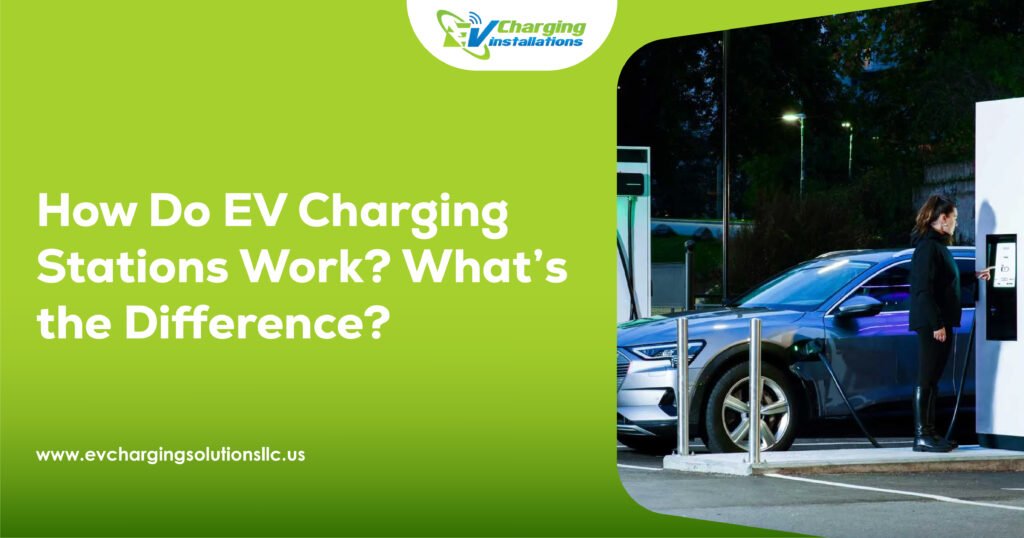
EV charging stations offer power grid electricity to the battery of an electric vehicle at a basic level. Nonetheless, as opposed to conventional fuel pumps, EV chargers need to be sensitive with the purpose of preventing damages to the vehicle and the power grid. When a car is parked the EV and the charging station communicate to each other prior to the transfer of any power. This preliminary handshake provides the compatibility, maximum charging capacity, and is a guarantee that all the safety requirements are achieved. The charging only commences after this process, thus the EV charging is a controlled and intelligent process instead of a mere transfer of power.
AC Power vs. DC Power in EV Charging
Among the most crucial notions in EV charging, one can distinguish the alternating current (AC) from the direct current (DC). The grid electricity is in AC format and EV batteries store energy in DC format. It is this difference that leads to the functioning of charging stations. AC charging systems have the charging station providing AC; the onboard charger transforms the AC into DC and then it is stored in the battery. Such a conversion restricts the rate of charging depending on the internal hardware of the vehicle.
DC charging stations, in their turn, accept the conversion externally. These stations take the AC power supplied on the grid and change it into DC, which is then applied straight to the battery. DC chargers are able to provide significantly larger power levels, bypassing the onboard chargers in vehicles and greatly decreasing the amount of time taken to charge. This difference is why there are chargers that would be more viable in overnight charging and there are those that are meant to be used quickly during long trips.
Want to understand the difference between AC and DC charging in more detail? Read this complete guide on DC fast charging and when it’s the right option for your EV.
Types of EV Charging Stations
The EV charging stations are commonly divided into three levels according to the speed and power output of the charging station. The slowest and Level 1 chargers work on standard household outlets and add a few miles of range per hour. They can be effectively used at home in cases where cars spend long durations in the parking lot.
Level 2 chargers use a higher voltage to charge and are usually placed at homes, offices, shopping centers, and parking lots. These chargers are also faster and can be used on a daily basis and most EVs can be fully charged in several hours.
DC fast chargers are the highest power and would normally be located along the highway and business corridors. In 20 to 40 minutes, depending on the vehicle and capacity of the charger, they can fill up an EV battery up to 80 percent. These stations are necessary when travelling long distances and in busy places.
Communication Between the Charger and the Vehicle
The contemporary EV charging stations are based on the digital communication. When the charger and the vehicle are connected, the charger and vehicle communicate battery status, temperature, voltage limits, and charging speed. This communication guarantees that the flow of electricity is at the most optimum rate without overheating or breaking down parts. Smart chargers have a dynamic charging speed, whereby the chargers slow down when the battery is full to lengthen the battery life and enhance efficiency.
A high number of the charging stations in the community are linked with cloud-based software solutions. These systems support user authentication, billing, remote monitoring and tracking of energy usage.
Safety Features Built Into EV Charging Stations
The critical feature of the way EV charging stations are operating is safety. The chargers will come with several protective measures to avoid electrical faults, overheating, and power bursts. Ground fault sensors, automatic shutoff control, and temperature control are used to guarantee that charging is stopped immediately in case something goes wrong. Enclosed in weatherproof cases and insulated connectors ensure the safety of users and equipment, enabling the use of EV chargers in the outdoors.
Also, EV charging connectors will be able to lock in place during charging to avoid disconnection or tampering. Such safety measures render EV charging as safe as, or even safer than, the traditional electrical appliances.
The Role of Power grid and smart energy management.
EV charging stations have strong connections with the electrical system, and smart energy management becomes even more significant in their functioning. Certain stations can manage the demand for power by charging the vehicles either at off-peak times or by varying the output when the grid demand is high. More advanced systems can also be used to incorporate the renewable energy, so that the chargers can draw on solar or wind energy when it is available.
With the increase of EVs, smart charging technologies can be used to avoid grid overload and achieve maximum efficiency. This causes EV charging stations to become not only consumers of energy, but also direct contributors to a more intelligent and more resilient energy ecosystem.
Conclusion
EV charging stations are designed based on a blend of electrical engineering, digital communication, and safety-oriented design as a way of providing power to electric vehicles efficiently. To transform power between AC and DC into real-time data transfer and integration into the grid, each element has its part in making the process of EV charging reliable and convenient. These stations will be further developed, becoming smart, quicker, and more convenient as charging technology is further advanced, and these changes will facilitate worldwide switching to more environmentally friendly and cleaner transportation.
Understanding how EV charging stations work is the first step. For expert guidance, installation, and long-term reliability, explore our professional EV charging solutions tailored for both homes and businesses.