With the increased presence of electric cars, the various categories of charging systems need to be clarified to the EV owners, businesses, and property developers. The most popular are Level 2 and Level 3 charging stations. Although they both are aimed at the same goal, that is, to charge an electric vehicle, their speed, technology, installation needs, and the best scenarios in which they might be used vary greatly. The dissimilarity between Level 2 and Level 3 charging can be known to help you select the appropriate solution according to convenience, cost, and charging requirements.
What Is Level 2 EV Charging?
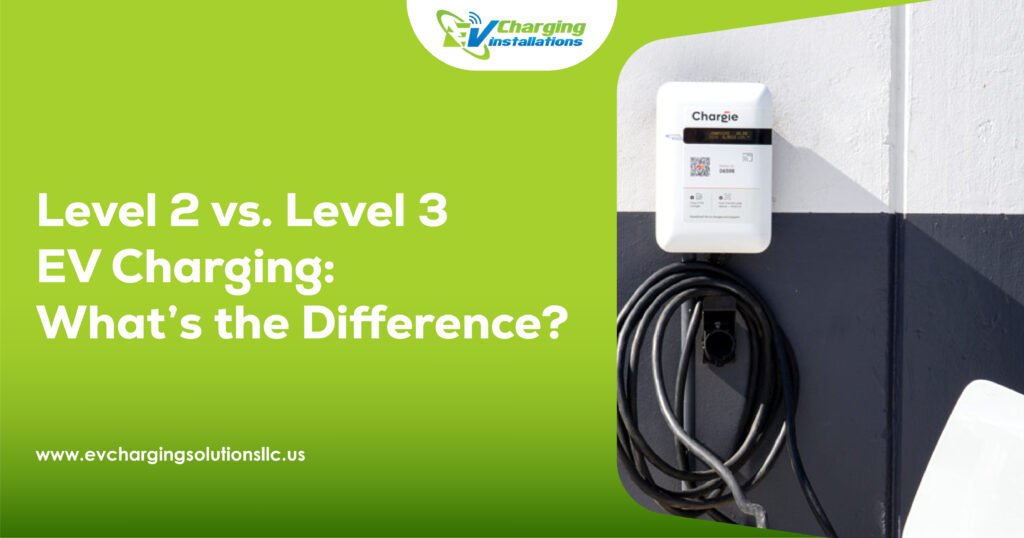
The most common charging that is used by everyday EV owners is Level 2 charging. These are charged using alternating current (AC) and usually are powered on a 240-volt power supply, as in a domestic device such as a dryer or oven. Level 2 chargers can be located in residential buildings, apartment buildings, offices, parking lots and places of common interest like malls and hotels.
Since Level 2 chargers are dependent on the onboard charger of the vehicle to turn AC power into direct current (DC), the rate of charge is reliant on the internal hardware of the car. The Level 2 charging can charge between 20 and 40 miles of range on average. This makes it convenient when charging night away at home or in the parking lot where a vehicle may spend a long time of the day. To the majority of EV owners, Level 2 charging provides a reliable and efficient way to meet the everyday driving necessities.
What Is Level 3 (DC Fast) Charging?
Level 3 charging, also known as DC fast charging, is designed for rapid energy delivery. Unlike Level 2 chargers, Level 3 stations convert electricity from AC to DC within the charger itself and send power directly to the vehicle’s battery. This bypasses the vehicle’s onboard charger and allows for much higher power output.
Level 3 chargers use much higher voltages and currents, allowing them to turn an EV battery to approximately 80 per cent in a few minutes (ranging between 20 and 40 minutes), depending on the vehicle and the capacity of the charger. Most of these chargers are located on highways, commercial routes, depots of the fleet and busy cities where quick turnover is of great importance. Level 3 is particularly useful in long-distance travel and commercial fleets that need to be maintained in the minimum time.
Understanding the differences between Level 2 and Level 3 EV charging is key to choosing the right setup. Explore our DC fast charging solutions for homes, businesses, and public spaces to make smarter EV charging decisions.
Charging Speed and Performance Comparison
The most noticeable difference between Level 2 and Level 3 charging is speed. Level 2 charging is steady and predictable, making it ideal for routine charging when time is not a constraint. Level 3 charging is dramatically faster but is generally used for short charging sessions rather than full battery replenishment.
Level 3 chargers slow down as the battery approaches full capacity to protect battery health, which is why most fast-charging sessions stop around 80%. Level 2 chargers, on the other hand, are better suited for bringing a battery to 100% over a longer period without stressing the system.
Installation and Infrastructure Requirements
Another major difference is in the complexity of installation. Level 2 chargers are quite easy to install and may, in many cases, be accommodated in an existing electrical infrastructure with some upgrades. This serves to make them affordable to homes and light commercial.
Level 3 chargers demand a large electrical capacity, special equipment, and frequently utility coordination. Installation costs are much greater and not every location can be DC fast charged with no important infrastructure investments. In this respect, Level 3 chargers are usually implemented where there is a strategic positioning, not everywhere.
Cost Considerations
Installation-wise and usage-wise, Level 2 charging is much cheaper. Level 2 chargers can be installed at a manageable price by homeowners and businesses and electricity charges tend to be cheaper during off-peak times.
Level 3 charging is more expensive to install and charge per session, particularly at the public stations. Although the ability to charge in a short period of time is highly desirable, it is not applied as a habitual pricing option but as a supplementary charging option.
Selecting the suitable Charging Level.
The determination of Level 2 or Level 3 charging is based on your needs. Level 2 charging is suitable for daily driving, home charging, workplaces, and places where vehicles spend long durations. Level 3 charging is the most suitable one in highways, fleet-based, and high-demand public charging settings where high speed is a necessity.
Conclusion
EV charging Level 2 and Level 3 charging stations have complementary purposes in the electric vehicle ecosystem. Level 2 charging offers a viable and affordable approach to daily usage and Level 3 charging offers performance and convenience when traveling long distances or facing peak demand situations. The knowledge of such distinctions assists the EV drivers and civil engineers in making more intelligent choices as the electric mobility transition proceeds to expand.
Ready to implement the right EV charging setup? Discover our EV charging solutions designed for homes, businesses, and public spaces to ensure safe, efficient, and reliable charging.