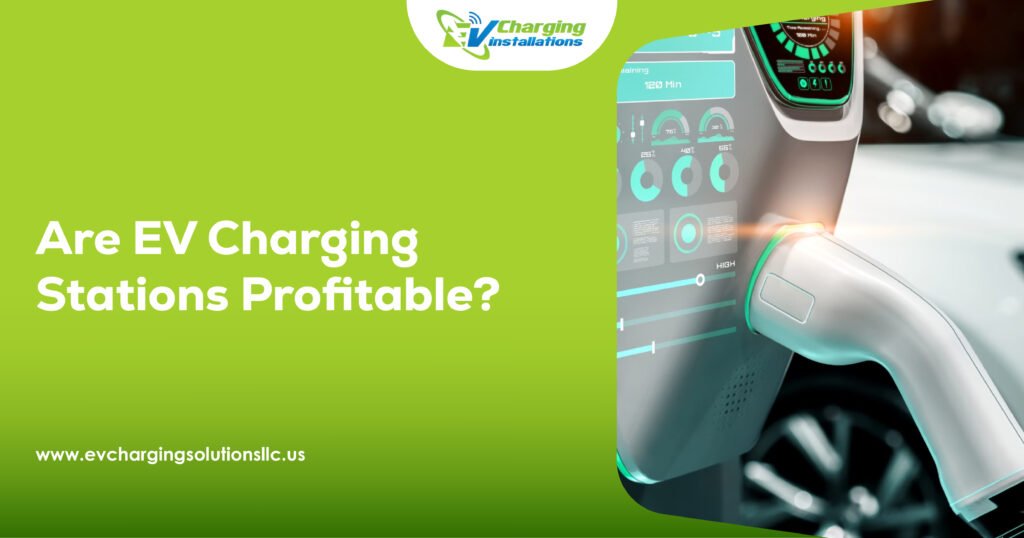
Electric vehicles (EVs) will no longer be a dream; they are quickly becoming a regular feature of transportation. EVs are increasingly popular in the global market as governments and consumers work towards cleaner energy solutions. This evolution raises an important question in the minds of the investors, property owners, and businesses, naturally, Are EV charging stations profitable?
The answer is yes, EV charging stations can be very lucrative. But as with any business venture, location, strategy, use, and long-term planning are a matter of profitability. We shall discuss how EV charging stations can earn money and why these stations can be financially successful.
The Growing Demand for EV Charging
The increase in the number of electric vehicles in the market makes the profitability of EV charging stations highly dependent. The demand to have a quality and convenient charging infrastructure grows as more consumers abandon gasoline-powered vehicles in favor of EVs.
The demand presents a good business and property owner market. Electronic payment stations are currently becoming a necessity even in shopping centers, office buildings, hotels, restaurants, parking areas and residential complexes. EV charging is not a fad; it is a long-term investment option with the tendency of the world transitioning toward sustainability and zero-emission transportation.
As EV uptake is growing, early adopters of charging infrastructure can usually get higher usage and branding.
How EV Charging Stations Make Money
EV charging stations earn money in a number of direct and indirect ways. The knowledge of these sources of income assists in the determination of their profitability.
Check out our detailed guide on Level 2 vs Level 3 EV Charging to optimize your investment.
Charging Fees
Electricity charging to the users is the most prevalent source of revenue. It can be charged by operators on a per-kWh (kilowatt-hour) basis, per session, or per hour. DC fast charging stations, in particular, tend to have higher rates since the speed and convenience are more likely to be valued.
Membership and Subscription Models.
Others have subscription packages, which will offer lower charges or allow unlimited charges up to a specific limit. These recurring payments give foreseen monthly earnings.
Advertising and Partnerships.
Digital advertising screens, brand partnerships or sponsored charging points can also be used to add further revenue to charging stations in high traffic locations.
Customer spending has increased.
Malls, restaurants, and hotels are some businesses that will have an indirect advantage of EV charging. During the time drivers are waiting to have their vehicles charged, they usually shop, dine, or access other services on the premise and this enhances customer spending and retention.
Factors That Affect Profitability
Not all EV charging stations are equally profitable. Several factors play a significant role in determining financial success.
Location
Location is one of the most critical factors. Charging stations in busy urban areas, highways, commercial districts, and travel hubs typically see higher usage and faster returns on investment.
A poorly located station with low EV traffic may take longer to become profitable, while a well-placed charger in a high-demand area can generate consistent revenue.
Type of Charging Station
There are three main types of EV chargers: Level 1, Level 2, and DC fast chargers.
- Level 1 chargers are slow and typically used in residential settings.
- Level 2 chargers are common in commercial and public spaces.
- DC fast chargers provide rapid charging and are ideal for highways and busy locations.
While DC fast chargers require higher upfront investment, they often generate higher revenue due to faster turnover and premium pricing.
Installation and Operational Costs
Initial expenses are equipment, installations, permits and electrical improvements. The recurrent expenses are electricity, maintenance, software and network management.
Nonetheless, in most areas, the installation of EV charging infrastructure is provided with government incentives, grants, or tax breaks. Such incentives may go a long way in lowering startup capital and enhancing profitability.
Utilization Rate
The higher the frequency of use of the charging station, the sooner it will pay back. When the utilization is high, the revenue will be steady, whereas when the utilization is low, the payback period of the investment can be lengthened.
Potential of Long-term Investment.
EV charging stations must be perceived as a long-term project, but not a fast-profit project. The number of charging demands is steadily growing as more and more people begin to use EVs each year. The stations that are installed now will be used and will increase revenue in the future.
Besides direct profits, EV charging does increase property value and business attractiveness. Commercial properties that provide charging stations appeal to customers, tenants and employees who are very conscious of the environment. This value addition can be in terms of occupancy rates and customer loyalty.
There are numerous companies that not only place charging stations to generate revenue, but also to indicate their progressive and eco-friendly nature. This brand image has the ability to generate competitive advantages in the new markets.
Challenges to Consider
EV charging businesses do not only have obstacles, despite being profitable. Margins can be affected by high initial expenses, changing technology and electricity rates. The competition is also on the rise with the entrance of more companies in the EV infrastructure market.
In order to be profitable, the operators need to make a decision on strategic locations, reliable equipment, and competitive prices. The use of smart software systems that track the use, price, and performance can contribute to the maximization of revenue and efficiency.
Conclusion
Therefore, are charging stations for EVs profitable? The response is a resounding yes- when it is planned and handled properly. As electric vehicle sales continue to rise and the world moves toward sustainable transport, EV charging infrastructure has a high potential to generate revenue for companies and investors.
The factors that determine profitability include the location, type of charger, utilization rate and the strategy of operation. Although it may be quite expensive in the short-term, it is a clever long-term investment due to the long-term returns and the increase in demand.
When the EV revolution is still in its early stages, invested stakeholders in charging infrastructure today are placing themselves at the head of a fast-growing and lucrative business.
Our EV charging installation services help businesses, hotels, and commercial properties maximize profits and attract EV drivers.